

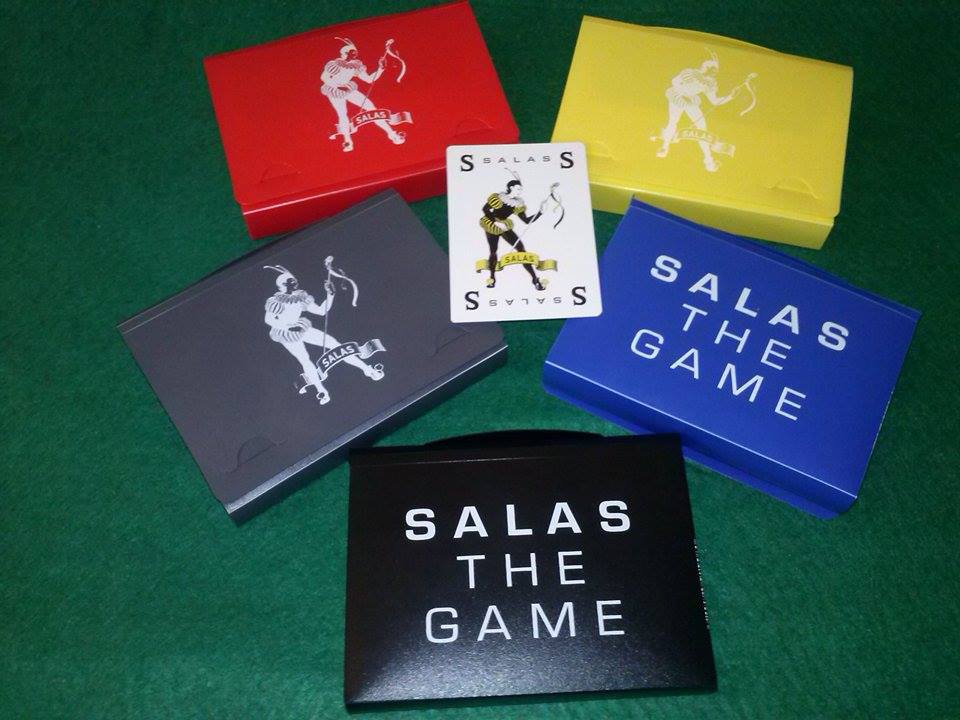
We place one Salas in the middle of the table. One player deals 11 cards to each participant, and the player cutting the deck creates two packs of 11 cards each.
We play with the aim of reaching 40 points in order to take the Salas from the middle and lay it down, which is mandatory to determine the trump suit in hearts. The goal is to form a "seven" or "sevens," close the game to take our pack from the table, and close again! (To "close" means that we have combined all our cards).
Whoever holds the card that replaces the Salas (e.g., 7, 8, 9, S of hearts) can take it by placing the 10 of hearts in the Salas position without being required to lay it down.
Players play in pairs and add or subtract their points together. Any pair that fails to lay down their cards intentionally or due to restrictions receives minus 250 points. Any pair that doesn't retrieve their pack gets minus 100 points.
These are the basics; the rest (restrictions, points, etc.) are in the instructions!
Now let’s play.
We measure who will play first and who will make the cards. In every hearts round, we always place one of the two Salas cards in the middle. The player who cut the deck deals the cards one by one and creates two packs of 11 cards, one pack for each pair. The dealer distributes 11 cards, either one or two at a time, to each player, placing the remaining cards face down in the middle of the table, along with any leftover cards from the pack creator. We play in a clockwise direction.
The trump suit is determined by the first player to take the Salas card from the middle, as they are required to lay it down as part of a combination, thus setting the trump suit for that round. However, aside from the Salas, the player must lay down at least 40 points in one or more combinations.
The 40-point requirement does not apply to the other players, who can lay down just a single set of three (as long as the 40 points and the Salas have already been laid down). Therefore, to reach 40 points, one must lay down a combination of four cards, two sets of three, or more to total 40 points. I repeat, the suit in which the Salas is combined becomes the trump suit for that round. The player who has the card that replaced the Salas can take it when it's their turn without being required to lay it down.
The points are recorded as follows:
The two Salas cards do not count for any points and cannot be used in the same combination. Jokers are worth 20 points. Twos (2s) are worth 10 points, both as 2s and as wild cards. Aces are worth 15 points. The cards K, Q, J, 10, 9, 8 are worth 10 points, and the cards 7, 6, 5, 4, 3 are worth 5 points each. The total points, if ending in five, are always rounded (+5) in favor of the pair!
If you are left with the Salas in your hand, it counts as minus 50 points.
We play clockwise with two options: either we draw a card from the deck, or we take the face-up cards as long as we can lay down at least one of them in a combination (a set of three, a set of four, or to attach it, etc.). We always discard one card for the next player to play.
This applies after the player who has laid down the Salas.
We continue playing until the hidden cards run out. We only make "pure" combinations! All cards must be combined with cards from the same suit, meaning spades only with spades, clubs only with clubs, diamonds only with diamonds, and hearts only with hearts. There is always the option to use a wild card, but only one per combination, except for twos (2s), which can also be used as a regular 2 in their suit.
For example, you can have 1, 2, 3, 4 all in clubs and then add the 5 of clubs, followed by any wild card and the 7 of clubs to form a "seven," and of course, the Salas card can also be placed in the position of the 3, 1, 4, or 7 to complete a "seven" with three wild cards! Another example could be a set of 2, S, Joker (2, 3, 4).
If wild cards are part of a set of three, for example, 7, 8, 2, you can add the 9 and 10 on top, or the 6 and 5 below. However, if the Salas is used, it must be declared when laid down in the 4, 5, or S position (if it’s a six or three); otherwise, the position where it was laid remains valid. If a player mistakenly places the Salas in the middle, like 4, S, 5, then anyone who holds the 3 or the 6 can take it without asking permission.
For a pair to retrieve their pack, they must lay down or complete at least a "seven" or "sevens" and close the game!
A "seven" is a sequence of 7 cards of the same suit (spades, clubs, diamonds, hearts), with the option of adding wild cards. After the pair retrieves their pack, they must also form a "sevens" to close again.
"Sevens" refers to a sequence of 7 cards of the same suit (spades, clubs, diamonds, hearts) where the Salas card can be used in any position without any restrictions!
If one of the players closes the game, they receive a bonus of 100 points, and the other three players record negative points based on the cards in their hands, but positive points for the ones they have laid down!
Any pair that doesn't manage to retrieve their pack gets minus 100 points.
If the deck runs out, each player records minus points based on the cards in their hands. The same happens when a player closes the game—the others record minus points for the cards still in their hands.
A player closes the game when they have used all their cards, without being required to discard one. If the player and their partner haven't retrieved their pack yet, they take it and continue! Even if they take the last card from the face-up pile or from the deck and close (without discarding), they take the pack and continue laying down cards, with the option to close again by discarding or not their last card.
Any pair that doesn't manage to lay down, even if they haven't reached the point limit of 75, 90, or 110, records minus 250 points without showing their cards.
The trump suit is determined by the suit where the first player places the Salas card in each hearts round, and it affects the scoring (in the "thirteen," "sevens," and "seven").
There are four suits (spades, clubs, diamonds, hearts), and they are all equal. A hearts round is the duration of the game from the dealing of the cards by each player until the next deal.
We cannot take a card from the pile and discard it again to avoid drawing.
The Salas can be taken by the same player who laid it down, but only after all players have played one round.
However, be careful—if a player is left with the Salas in their hand, they record minus 50 points.
The scoring for combinations is as follows:
- A "seven" (referred to as eptaraki) is worth 100 points.
- A "sevens" (eptare) is worth 200 points.
- A "seven" with trumps is worth 300 points.
- A "sevens" with trumps is worth 600 points.
- A "thirteen" with a wild card (or joker) is worth 200 points.
- A "thirteen" without a wild card or with only the help of Salas is worth 500 points.
- A "thirteen" with trumps or with only the help of Salas is worth 1,000 points.
We recommend starting with the following restrictions until you become familiar with the game. The winning pair is the one that exceeds 6,001 points. If both pairs exceed 6,001 points, the one with the higher score wins.
If we want to allow combinations to help our partner lay down cards and thus create "sevens" or "sevens" to close and retrieve the pack, we can do so before the restrictions begin. Any pair that fails to retrieve their pack scores minus 100 points. This applies until they reach 999 points.
After that, a player can only take face-up cards or lay down combinations if they have laid down more than 75 points, and the Salas must be in play to determine the trump suit.
This restriction (75 points) applies when the pair has between 1,000 and 2,499 points.
- From 2,500 to 3,999, the requirement is 90 points, always with the Salas in play for trump determination.
- From 4,000 to 6,000, the requirement is 110 points, again with the Salas in play.
Any pair that does not meet the threshold set by the restriction scores minus 250 points without showing their cards. When both pairs exceed 6,001 points, the pair with the higher score wins.
The game can also be played under the same terms with three pairs but using three decks!
If you want to play with two players, the only difference is that you will deal and create packs of 13 cards.
We apologize for repeating some terms, but we believe it helps in understanding Salas.
Once you become familiar with the game, you can introduce the DET rule: If both pairs exceed 6,000 points, the round is a draw, and it does not matter who scored higher! However, if it’s a final round and you want a winner, you play an additional two or four rounds as follows:
The player whose turn it is deals, and the pairs lay down cards with only the initial requirement of 40 points from Salas. From there on, in the two or four rounds, whichever pair scores the most points wins.
Have fun!
Note: In the championship, different restrictions will apply. These restrictions will be proposed by you, and we will decide together!
Announcement: The name SALAS comes from the names SAKIS and LAZAROS ARVANITAKIS (SA kis – LA zaro S).
We have designed the game in such a way that you can add as many rules as you want to make it more challenging. It is our intellectual property, and anyone wishing to play it in a public space (cafes, clubs, etc.) must have our written consent (Law 2121/1993).
Even the deck of cards is our production, and the symbols and the Salas are our inspiration!
For any questions or information, please contact us at email: